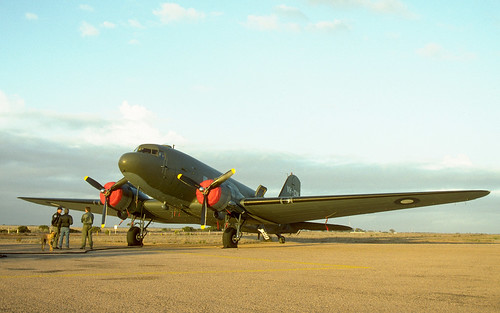
RAAF C-47 Skytrooper taking a break at Ceduna en route to Point Cook. 18 May 1996. VH-CIN. This aircraft is immaculate.
For a modern air force, the Dakota may seem an anachronism, but it is hard to find an alternative type. The only problem such an antiquated piece of equipment presents is, in fact, to some of the younger pilots, who need to learn how to fly it with skill and grace! A very experienced Dakota pilot stated that once in the air it was easy enough for him to fly, but to fly it nicely was another matter, and to handle it on the ground was even harder. Dakota pilots need to be careful as it is easy for the aircraft to lose directional control with the tailwheel on the ground when travelling at any great speed. Most young pilots converting onto the Dakota admit to having initial problems with directional control, some even admitting they had left the runway sideways rather than upward on some early flights before they learned to anticipate the swing! Part of the reason for this apparent lack of airmanship is the absence of previous experience on tail-wheeled aircraft, or indeed any aircraft with such insensitive controls, for by comparison both the Airtrainer and Macchi are sweet-handling tricycle-geared machines with a more positive response. - Greg Meggs, Australian Air Power Today, Kookaburra Publication, 1988
About McDonnell Douglas


